Passing and receiving are the foundation of every team.
The ability to move the ball quickly, control it cleanly, and make the right decision under pressure is what separates good teams from great ones.
These drills focus on improving technique, awareness, and decision-making in real game situations.
Core Principles
- Quality of pass: improve accuracy, weight, timing
- First touch control: so you can set up the next action
- Movement off the ball: to create passing options
- Play with purpose: and avoid unnecessary touches
Key Coaching Points
- Passing
- Use the correct surface on your feet, inside for control, laces for power
- Pass with intent, don’t just move the ball
- Timing matters so make sure to release at the right moment
- Communicate using verbal and visual cues
- Receiving
- First touch away from pressure
- Open body shape so you can see more of the pitch
- Prepare early and scan before receiving
- Control into space and not back into danger
Passing and Receiving Drills
Perpetual Passing & Moving
Objective: Develop timing, movement, and first touch through continuous passing and rotation.
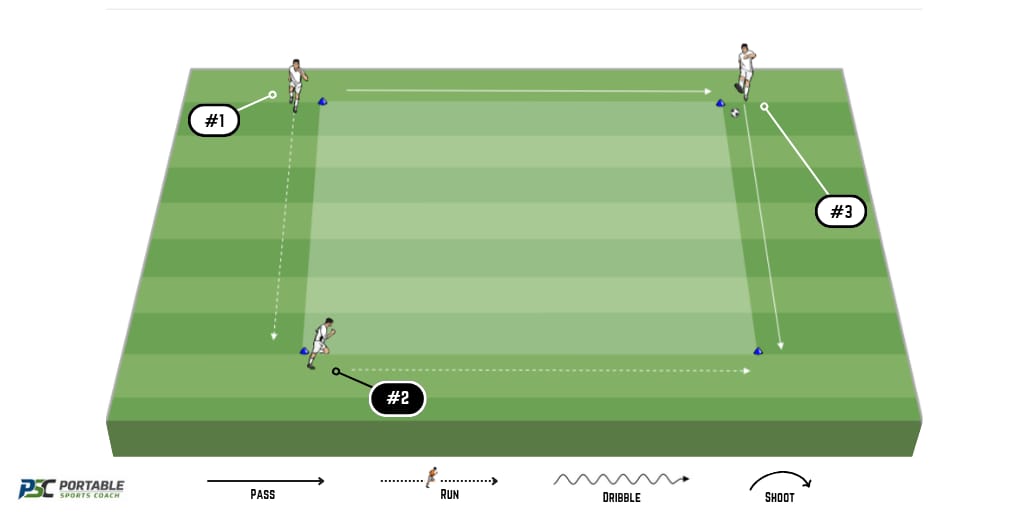
Setup
- Players: 3
- Area: Medium-sized square (larger than short passing range)
- Equipment: Balls, cones
- Starting Position:
- 1 player on each corner along one side of the square
- 1 player starts on the opposite side
- Ball starts with Player 3
Instructions
- 1. Player 1 begins by running along the line of the square.
- 2. On this movement, Player 2 runs to receive the ball being passed from Player 3
- 3. Player 2 receives, turns, and passes back to Player 1.
- 4. After passing, Player 2 runs to where player 3 started
- 5. Player 1 receives and plays the ball down the line to Player 3.
- 6. Player 3 receive the ball, turns and plays it to Player 2
- 7. Repeat the sequence continuously, rotating positions.
Coaching Points
- Time the runs: move as the pass is about to be played don’t be too early or too late
- Quality of first touch: set up the next action by receiving the ball and taking a touch away from the body
- Pass with purpose: play the ball with the correct weight and direction
- Follow your pass (where applicable): to maintain flow and structure
Progressions
- Limit touches (2-touch / 1-touch): to help increase speed of play
- Change direction of play: so they can work both sides
- Add a passive defender: to introduce pressure and realism
- Reduce space: increase difficulty, increase tempo and reduce room for error
360-Degree Passing and Receiving
Objective: Improve first touch, passing accuracy, and 360° awareness with constant movement and high repetition.
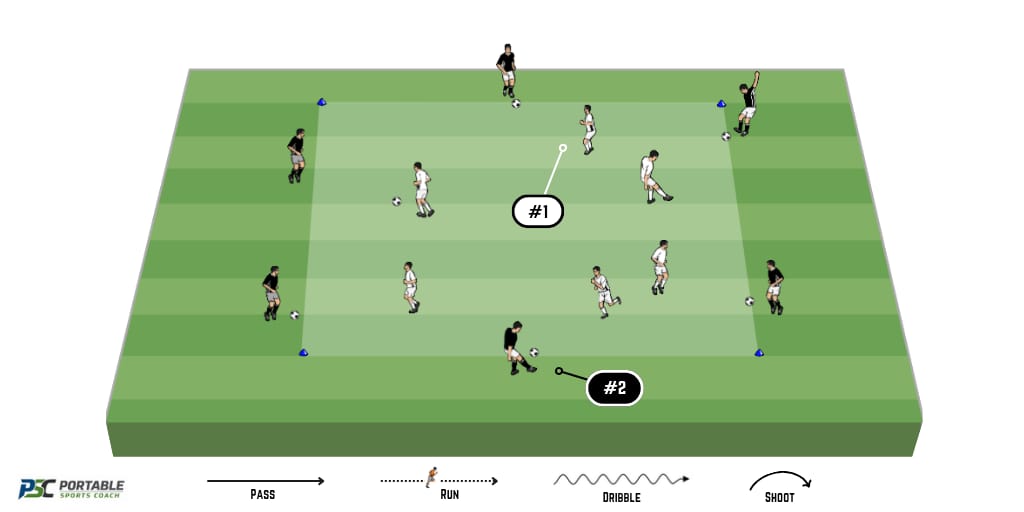
Setup
- Players: 12 players (6 outside, 6 inside)
- Area: 15–25 yard square (adjust based on level)
- Equipment: 6 balls (1 per outside player), cones to mark grid
- Starting Position:
- 6 players positioned evenly around the outside with a ball each
- 6 players inside the grid, moving freely
Instructions
- 1. Inside players move continuously within the grid
- 2. Approach an outside player to receive a pass
- 3. Receive the ball and return it to the same player
- 4. Move away immediately to find a new player
- 5. Maintain high tempo with all players working simultaneously
Coaching Points
- Passing:
- Firm, accurate pass, play with the right weight to feet
- Pass to correct foot to help the receiver play quickly
- Minimal touches so you can move the ball quickly and efficiently
- Receiving:
- Scan before receiving and check shoulders before the ball arrives
- Open body shape to receive side-on to play forward
- First touch direction, set up the return pass immediately
- Stay on the move and don’t stand still after passing
Progressions
- Turn and play to new player: receive, turn, and pass to a different outside player
- Two-touch limit: increase speed of play and decision-making
- Add defenders: introduce pressure inside the grid
- Time restriction: force quicker actions under pressure
1v1 Channel Defending
Objective: Teach defenders how to delay attackers, control space & direction, and win the ball without diving in.
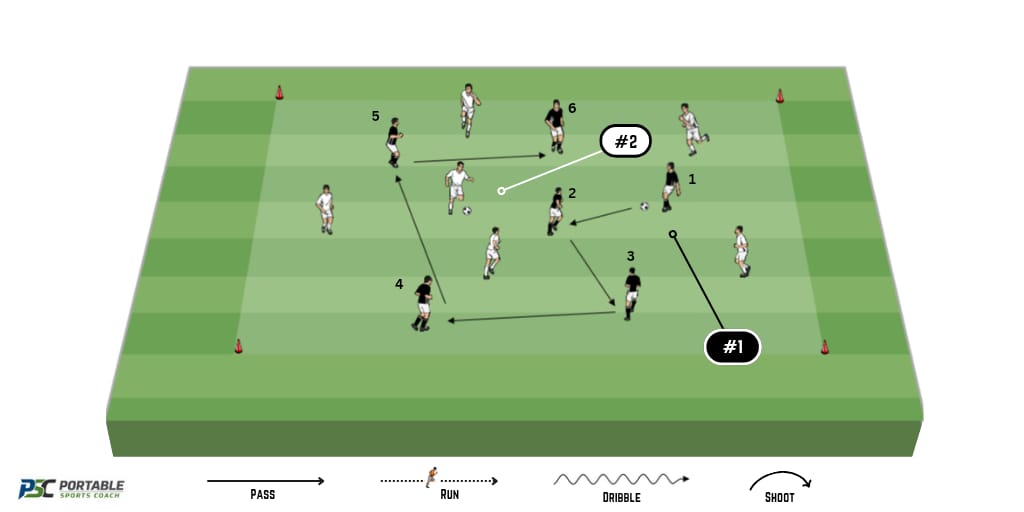
Setup
- Players: 12 players split into 2 teams of 6
- Area: 15 to 25 yard square
- Equipment: 2 balls, cones to mark grid
- Starting Position:
- Both teams inside the same grid with one ball per team
Instructions
- 1. Both teams pass and move freely within the same grid
- 2. Each team maintains possession of their own ball
- 3. Players must pass and receive while avoiding interference from the other team
- 4. Movement, awareness, and communication are key due to shared space
- 5. Play continuously at high intensity
Coaching Points
- Passing:
- Accuracy over force to keep passes controlled and consistent
- Timing of pass to release the ball at the right moment under pressure
- Create angles and move to support and provide clear passing options
- Receiving:
- Scan constantly and be aware of both teams and available space
- First touch control to keep the ball tight in crowded areas
- Body position to receive side-on to play quickly
- Find space and adjust positioning to stay available
Progressions
- Add outside target players: Move one player from each team outside to create directional play and more structure
- Pass then move rule: Players must pass and receive from a different teammate to increase movement
- Consecutive pass scoring: Teams earn points for completing a set number of passes under pressure
- Passive defensive pressure: Opposing players apply light pressure without tackling to increase realism
- Active interceptions allowed: Players can win the other team’s ball to create chaos and competition
- Two-touch limit: Restrict touches to increase speed of play and decision-making
Four Grid Overload Rondo (Passing & Receiving)
Objective: Improve passing and receiving in overload situations while developing awareness, movement, and quick support play between grids.
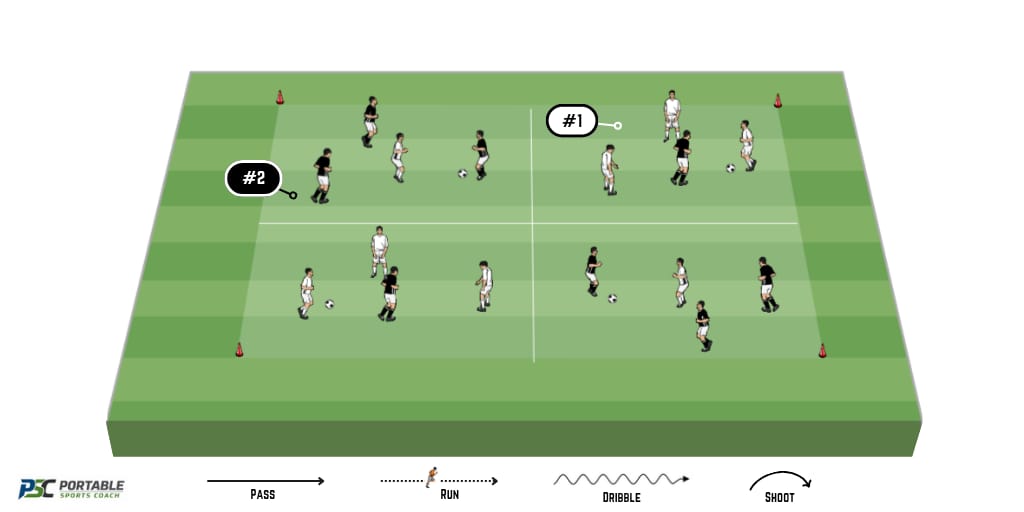
Setup
- Players: 16 players split into 2 teams of 8
- Area: Large square divided into 4 equal grids
- Equipment: 2 balls, cones to divide grids
- Starting Position:
- Each grid contains a 3v1, with opposite corners assigned to each team’s overload
Instructions
- 1. Set up four equal grids inside a larger square
- 2. Two opposite grids have one team as the 3 and the other as the 1
- 3. The remaining two grids mirror this for the opposite team
- 4. Each grid runs a 3v1 rondo simultaneously
- 5. On the coach’s command, one player from an overload grid leaves to support a teammate in an underload grid
- 6. The receiving grid becomes a temporary overload while the original grid becomes more of a challenge for team in possession
- 7. Play continues with constant movement and rotation
Coaching Points
- Passing:
- Accuracy over force to keep passes controlled and consistent
- Quick ball speed to move the defender and create space
- Pass with purpose to support the next action and maintain flow
- Receiving:
- Scan before receiving and be aware of pressure and support options
- First touch direction to move the ball away from pressure
- Body position to receive side-on and play quickly
- Support movement to constantly create passing angles
Progressions
- Timed rotations: Players must rotate between grids every few seconds to increase tempo and awareness
- One-touch finish phase: Players must complete the final pass in one touch to speed up decision-making
- Mandatory support runs: After a set number of passes, a player must move to support another grid
- Defender transition: The defender who wins the ball switches roles with the player who lost it
- Two ball overload: Introduce a second ball into one grid to increase difficulty and chaos
- Scoring system: Teams earn points for completing a set number of passes before transitioning
Timing the Pass Drill
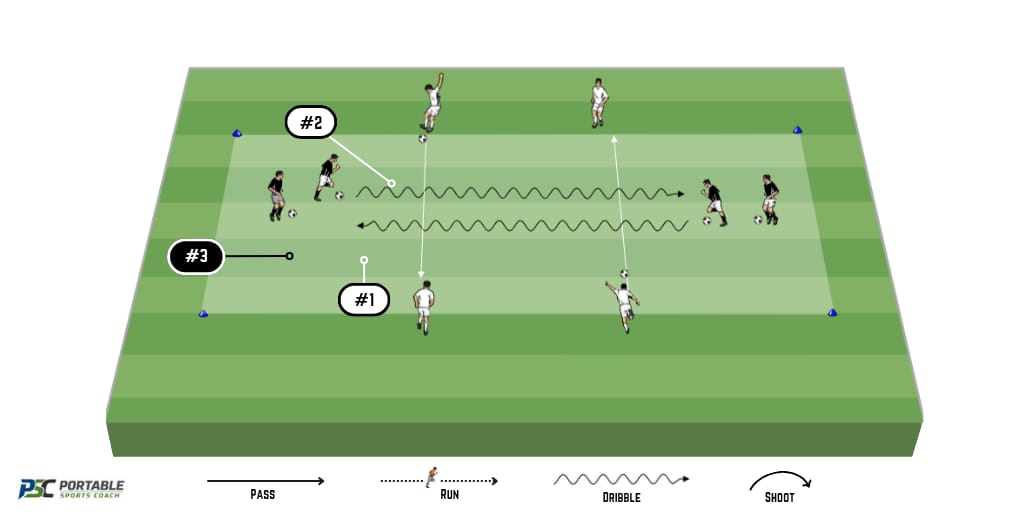
Objective: Develop timing and awareness by playing passes through moving players without disrupting their movement.
Setup
- Players: 8+ (2 teams of 4+)
- Area: Large rectangle
- Equipment: Balls, cones
- Starting Position:
- Passing players are positioned along the long sides in pairs, facing opposite each other with one ball per pair
- Two dribblers start at each end of the rectangle with a ball
Instructions
- 1. Passing players begin by passing the ball across the width of the rectangle to their partner.
- 2. At the same time, one player from each end dribbles through the rectangle in opposite directions.
- 3. Passing players must time their passes to avoid hitting the dribblers moving through the middle.
- 4. Dribblers focus on moving through the space using controlled touches or running with the ball.
- 5. Rotate the dribblers regularly and continue the drill.
Coaching Points
- Passing
- Accuracy over force to keep passes controlled and consistent
- Timing of pass to release the ball at the right moment as space opens up
- Awareness of movement to recognise when it is safe to play through
- Decision-making to delay the pass when the lane is blocked
- Dribbling:
- Close control in tight areas to avoid losing possession
- Longer touches when space opens up to move efficiently
- Head up when possible to stay aware of passing lanes
- Adjust speed and direction to avoid collisions and maintain flow
Progressions
- Add more dribblers: Increase the number of players moving through the middle to create more traffic and force better timing decisions.
- Diagonal passing: Instead of passing directly opposite, players pass diagonally to create different angles and decision-making challenges.
- Limit touches: Restrict players to two touches or one touch to increase the speed of play and improve decision-making.
- Increase dribbling speed: Encourage dribblers to move faster through the area to make timing more difficult for the passers.
- Add passive defenders: Introduce defenders who apply light pressure to increase realism without fully disrupting the flow.
Bowling Wars (Passing Accuracy)
Objective: Improve passing accuracy and decision-making under pressure in a competitive environment.
Setup
- Players: 8–12
- Area: Large grid (size adjusted based on age and ability)
- Equipment: Balls, cones
- Starting Position:
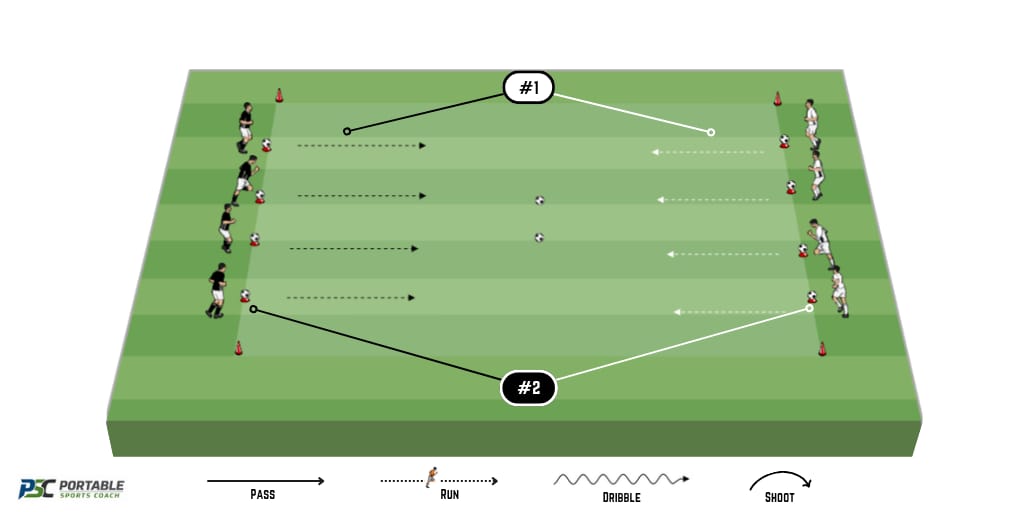
- Players split into two teams lined up opposite each other
- Each player has a cone in front of them with a ball placed on top
- Two balls are placed in the middle of the grid
Instructions
- 1. On the coach’s command, players sprint into the middle to compete for the two balls.
- 2. Players who win possession begin passing with teammates.
- 3. The aim is to knock the balls off the cones on the opposition’s side using accurate passes.
- 4. Players must pass and receive while looking for opportunities to strike the opponent’s cones.
- 5. If a player’s ball is knocked off their cone, they are out of the game.
- 6. Continue until one team has no players remaining or a winner is decided.
Coaching Points
- Passing:
- Accuracy over power to consistently hit the target
- Head up before passing to identify the best cone to aim for
- Weight of pass to ensure control while still being effective
- Decision-making to choose the right moment to attack or retain possession
- Receiving:
- First touch control to set up the next action quickly
- Awareness of space and pressure when receiving the ball
- Body position to receive side-on and play forward efficiently
- Movement after passing to stay involved and support teammates
Progressions
- Add more balls into play: Introduce additional balls in the middle to increase intensity and decision-making under pressure.
- Limit touches: Restrict players to two touches or one touch to increase speed and challenge control.
- Require minimum passes: Teams must complete a set number of passes before attempting to knock a cone off.
- Add movement to cones: Instead of static cones, allow players to adjust position slightly to avoid being hit.
- Introduce defenders in middle: Add neutral defenders who can intercept passes to increase difficulty and realism.
Passing and Support
Objective: Develop passing, receiving, and support play through overlapping runs and continuous movement.
Setup
- Players: 10 (2 teams of 4 + 2 neutral/support players)
- Area: Large grid
- Equipment: Balls, cones, bibs/pinnies
- Starting Position:
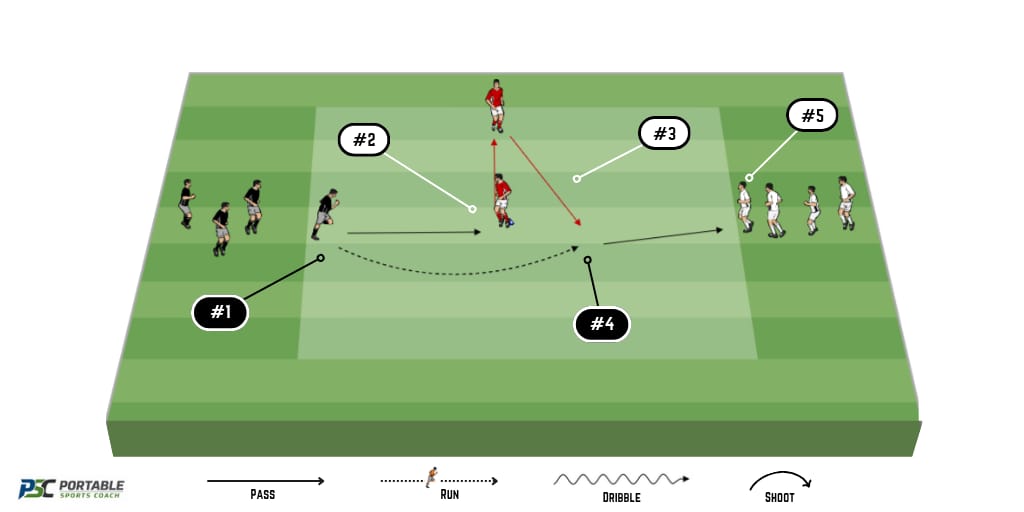
- Two teams of 4 stand in lines opposite each other
- Two neutral players stand in the middle wearing different colored bibs
- Ball starts with one of the outside teams
Instructions
- 1. Play starts with a pass from one team into a neutral player in the middle.
- 2. The player who made the pass makes an overlapping run around the neutral player.
- 3. The neutral player passes the ball out to the opposite side.
- 4. The receiving player then plays a pass into the overlapping runner.
- 5. The overlapping player receives and plays the ball to the next player on the opposite team.
- 6. The sequence continues in a flowing, continuous pattern.
Coaching Points
- Passing:
- Accuracy of pass to ensure smooth flow between players
- Timing of pass to match the movement of the overlapping runner
- Weight of pass to allow quick control and continuation
- Decision-making to keep the rhythm of the drill consistent
- Receiving:
- First touch into space to prepare for the next action
- Body position to receive side-on and see both sides of play
- Awareness of the next pass before receiving
- Control under movement to maintain the tempo of the drill
- Movement:
- Timing of overlapping run to arrive at the right moment
- Speed of movement to support the play effectively
- Angle of run to create a clear passing lane
- Continuous movement to stay involved in the drill
Progressions
- Limit touches: Restrict players to two touches or one touch to increase speed and sharpness.
- Add a second neutral player touch restriction: Force neutral players to play one-touch to increase tempo.
- Introduce passive defenders: Add light pressure in the middle to challenge decision-making.
- Change direction of play: Reverse the pattern to work both sides evenly.
- Add competition: Time how many successful sequences can be completed without error.
1v1 Channel Defending
Objective: Improve passing, receiving, and decision-making in overload situations to create and finish attacking opportunities.
Setup
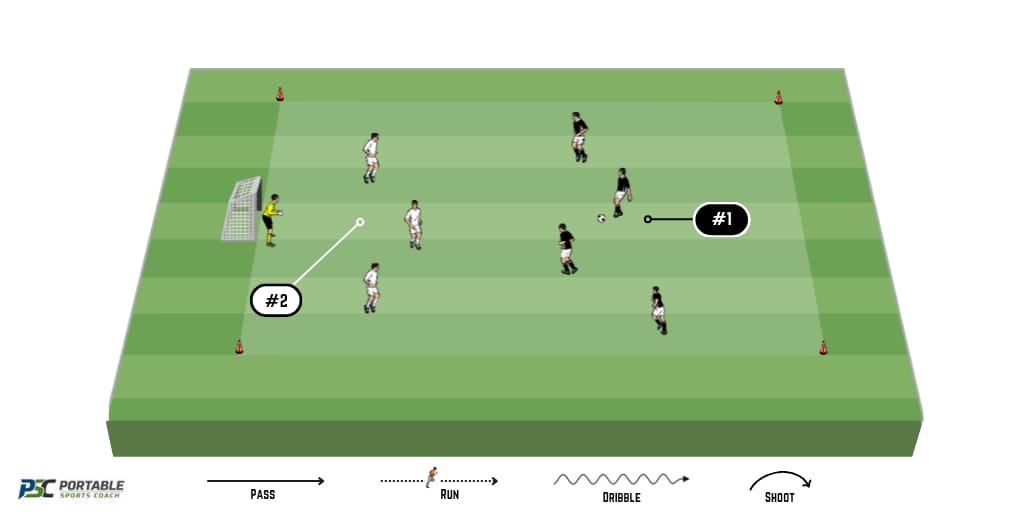
- Players: 7 outfield (4 attackers, 3 defenders) + goalkeeper
- Area: Small-sided pitch
- Equipment: Balls, cones, goal
- Starting Position:
- 4 attackers set up in attacking positions
- 3 defenders set up to protect the goal
- Goalkeeper in goal
- Ball starts with the attacking team
Instructions
- 1. Play starts with the attacking team in possession.
- 2. Attackers use their numerical advantage to create space and progress towards goal.
- 3. Defenders work together to delay and prevent a shot.
- Attackers aim to create a clear scoring opportunity using quick passing and movement.
- 4. If defenders win the ball, they can clear or play out depending on your setup.
- 5. Reset and rotate players after each attack.
Coaching Points
- Passing:
- Move the ball quickly to take advantage of the extra player
- Accuracy of pass to maintain possession under pressure
- Weight of pass to allow quick combinations
- Decision-making to recognize when to pass, combine or shoot
- Receiving:
- First touch into space to avoid pressure from defenders
- Body position to receive side-on and see multiple options
- Awareness of defenders and teammates before receiving
- Control under pressure to keep the attack flowing
- Movement:
- Create angles to support the player on the ball
- Use width and depth to stretch the defence
- Timing of runs to exploit gaps in the defence
- Constant movement to maintain the overload advantages
Progressions
- Limit touches: Restrict attackers to two touches or one touch to increase speed of play.
- Add time limit to score: Forces attackers to use the overload quickly before defenders recover.
- Allow defenders to counter: Add mini goals or targets for defenders to increase realism.
- Rotate overload (3v4): Swap roles so attackers experience underload situations.
- Start from different entry points: Vary where the attack begins to create different scenarios.
1v1 Channel Defending
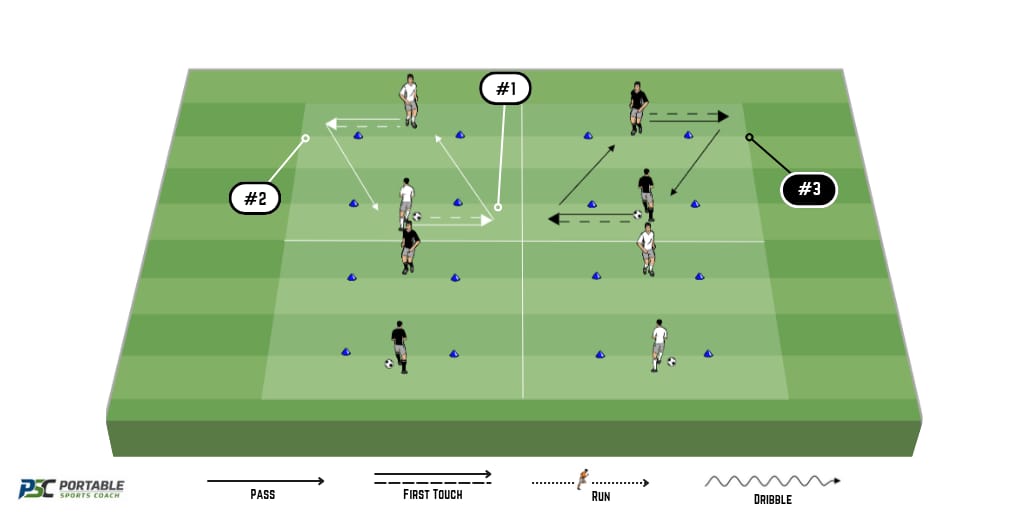
Objective: Develop first touch control and passing accuracy by receiving across the body and playing through the middle.
Setup
- Players: Pairs (can run multiple grids at once)
- Area: Small square (marked with 4 cones)
- Equipment: Balls, cones
- Starting Position:
- One player on each side of the square, facing each other
- One ball per pair
Instructions
- 1. Player A starts with the ball and passes across the square to Player B.
- 2. Player B uses their first touch to move the ball across their body toward the side of the square.
- 3. Player B then plays a return pass through the middle of the square back to Player A.
- 4. Player A repeats the same pattern.
- 5. Continue the sequence, focusing on clean control and consistent passing.
Coaching Points
- Passing:
- Accuracy of pass to ensure it travels cleanly across the grid
- Weight of pass to make it easy to control and play quickly
- Consistency of passing to maintain rhythm between players
- Decision-making to adjust the pass based on the receiver’s position
- Receiving:
- First touch across the body to move the ball away from pressure
- Control of the ball to set up the next pass cleanly
- Body position to receive side-on and stay balanced
- Awareness of space to direct the first touch effectively
Progressions
- Two-touch limit: Players must control and pass using only two touches to improve speed and efficiency.
- One-touch passing: Players attempt to return the ball first time to increase difficulty and sharpness.
- Alternate feet: Players must receive and pass using both feet to develop weaker side ability.
- Increase distance: Expand the size of the square to challenge passing accuracy and control.
- Add passive defender: Introduce light pressure to simulate a more realistic game scenario.